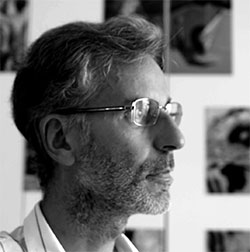
I was born in Vicenza in 1965. After completing classical studies in high school, I graduated in physics from the University of Padua and earned a PhD in theoretical physics at the University of Trieste.
Alongside my research in physics, I have always cultivated a deep interest in the arts, particularly visual arts and music. My passion for photography emerged gradually, shaped in large part by the influence of the great masters of cinema.
My approach to photography is both complementary to and closely connected with my work in physics. Both are driven by the pleasure of discovery: revealing what already exists, yet often escapes our attention at first glance.
My way to photography
I am more interested in creating an imaginary world than in merely reproducing or documenting reality. Yet my work remains a form of street photography, and what appears in my images is often closer to reality than it might seem at first glance.
I do not feel bound to any single photographic or printing technique. Over the years, I have explored a wide range of processes, from historical methods such as pinhole photography and gum printing to contemporary digital photography and printing—often combining old and new techniques within the same work.
Old techniques
Photography typically produces a two-dimensional surface in which the original perspective and sense of space are profoundly altered, if not entirely dissolved. Yet a photographic print is also a three-dimensional object—something that can be held, handled, and touched. It therefore possesses a material and tactile presence. The film itself contains a structure, its grain, which contributes to the texture of the final image; in other cases, the texture is shaped by the paper on which the photograph is printed.
I am interested in exploring these material qualities through experimentation with a variety of non-photographic papers, including Japanese paper and handmade cotton paper, in both black-and-white and colour processes. In black-and-white printing, after optionally sizing the paper with a gelatin coating, I brush on a light-sensitive silver gelatin emulsion and process the print in the darkroom.
My colour work ranges from inkjet printing with archival pigments on brush-coated Japanese paper to the more demanding gum bichromate process on handmade cotton paper. For the latter, I prepare the different layers of UV-sensitive photographic emulsion myself, pigmenting them with yellow, magenta, and cyan watercolours, as well as other pigments when desired. In the final print, the fine grain and detail of the original negative are partially lost, giving way instead to the traces of the brushwork and the texture of the paper fibres.
3D
My experiments with 3D lenticular printing continue the same line of research into the possibility of creating a tactile visual experience. In these works, the impression of depth is generated through the digital transformation of a two-dimensional photograph. The resulting spatial structure is intentionally detached from the actual depth of the original scene, producing a visual experience that is at once disorienting and engaging.
Videos
Viewing an image always unfolds through time, since no picture can be fully grasped in a single glance. Creating a sequence—a film—is a way of shaping and organizing this movement through time, while also allowing me to work with the interplay of image and sound. Through memory, individual scenes and the emotions they evoke merge into a larger experience, like a walk through an exhibition. In this process, two-dimensional photographs are transformed into a three-dimensional perceptual space. A further development of this idea is the integration of virtual three-dimensional video environments into this memory-based spatial experience.
Virtual reality
For me, panoramic three-dimensional video represents a further step in the transformation of photographic material toward a fully immersive aesthetic experience. Unlike conventional video, where the frame defines what is visible, here the viewer sees only a portion of the scene at any given moment, while events continue elsewhere, outside the field of view. Watching such a work therefore becomes an open experience: no one perceives everything that occurs, and each viewer constructs a different, personal journey through the visual material.
The natural extension of 360-degree video is the creation of virtual reality applications, in which the viewer is no longer limited to choosing where to look, but can also move within the virtual space itself. In this way, one can truly walk through a visual and musical world.
Selected Exhibitions
Spazio Cromatico and Toccata
Intersezioni Digitali, S. Martino di Lupari, Italy
Rilievi and Toccata
Traverse Video Festival, Toulouse
AMUSESSPACE
Friedenauer Kammersaal, Berlin
Les Ombres Errantes
Traverse Video Festival, Toulouse
Museo Nuova Era, Showville, Bari
Berlin, poesia nascosta di una città / verborgene Poesie einer Stadt,
Scuderie di Palazzo Moroni, Padua
View documentationBerlin, poesia nascosta di una città / verborgene Poesie einer Stadt,
Italian Cultural Institut, Berlin
View documentationPublications