Mare
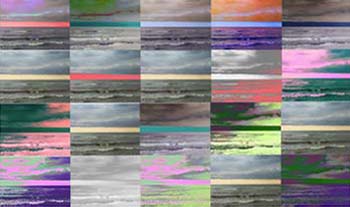
The project began with the image above, created by assembling 20 variations of the same scene — a photograph of a seascape altered through different colour treatments. In each column, one version of the scene retains its original colours. At the time the photograph was taken, I also recorded a video of the same landscape.
I then decided to introduce motion into the composition by creating a high-definition film based on the recorded footage, using a process similar to the one applied to the still image. Designed for projection on a large HD screen or display on an HD television, the work evolves continuously as each block changes independently over time.
Touching the Wall
.jpg)
At the origin of this project lies Clavicle, a composition for clavichord written in 2004 by the British composer Julia Usher. The piece explores the experimental sonic possibilities of the fretted clavichord, using sounds produced not only through the keyboard, but also through direct interaction with the strings themselves.
Fascinated by this music, I set myself the challenge of associating a synchronised sequence of images with its sounds, thereby creating my own interpretation of the score on both a musical and visual level. The work received the enthusiastic appreciation of the composer, and together we decided to merge the two creations into a single work: TOUCHING THE WALL.
The visual component is not conceived as a parallel track, but as something intimately connected to the music — its timing, spacing, and colour. Likewise, the music is not merely a soundtrack for the images: the two elements are inseparable.
L'Oscuro
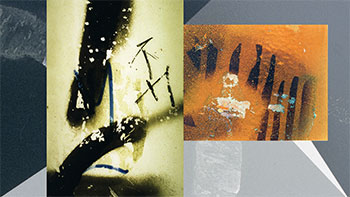
This video explores the interplay between static images flowing the one into the other through fadings and superpositions, and the flow of mental images recalled by a poetry, "l'oscuro" (the darkness) by Elisabetta Abbondanza.
View on YouTubeTiento (3D video)
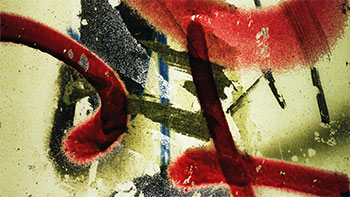
An ancient piece of music — a tiento by the Spanish Renaissance composer Antonio de Cabezón — performed by me on the clavichord, serves as the storyboard for a flow of abstract images layered in three dimensions. The result is a virtual “living sculpture.”
AMUSESSPACE
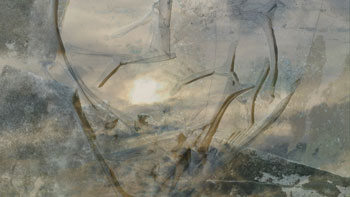
AMUSESSPACE consists of three short 3D videos exploring the interplay between music and vision, as well as the scientific ideas underlying their relationship. Music functions not merely as accompaniment, but as the very foundation upon which the visual structures are built. The aim is to give musical ideas a visual dimension, “projecting musical structures into space.”
The viewer is invited into an enhanced listening experience that moves from modal to tonal and atonal music, while also engaging with the microtonal nuances of non-equal temperaments. At the same time, perception itself is challenged through immersion in an unreal, fantastical environment created by eliminating all references to recognizable spatial coordinates. Three-dimensionality is not used as a supplementary effect; it is inseparable from the concept of the work itself.
Through their deep interconnection, music and visuals reinforce one another. The almost hypnotic atmosphere they create, together with the immersion in virtual space, leads the viewer beyond the purely intellectual dimension toward a dreamlike emotional experience.
The project consists of the following videos:
Sinfonia [6 min.] / Durezze e Ligature [5 min. 40 sec.] / Mysterium [2 min. 52 sec.]
The first and introductory video is a visual interpretation of a fugato-style composition by Johann Sebastian Bach, representative of an era in which the scientific study of light began to develop under the belief that colours and sounds obeyed the same laws of nature. This idea emerged from the Baroque aspiration toward the unification of the arts, particularly music and the visual arts.
The second video is based on a composition by Girolamo Frescobaldi, emblematic of the Baroque fascination with contrasts — light and shadow, consonance and dissonance, sudden gestures and suspension. These elements are translated visually through the construction of a virtual theatrical space composed of overlapping wings, shifting scenery, bright illuminations, and deep shadows, opening onto seemingly endless horizons.
The trilogy concludes with a video inspired by one of the final works of Alexander Scriabin, the composer who most radically explored the relationship between sound and colour through the scientific discoveries of the nineteenth century concerning the laws of light and acoustics. His work crowned centuries of research while opening the way toward a new cultural era. Delicately nuanced colours and layers of slowly moving, diaphanous forms evoke the mystical atmosphere suggested by the music itself.
The title of the trilogy, AMUSESSPACE, may be read as “a space of the Muses,” alluding both to the construction of a virtual environment and to the Muses, traditionally regarded as symbols of the unity of the arts — including science. At the same time, “a-muse” evokes the idea of amusement: the intellectual and sensory pleasure generated by this immersive visual experience.
PASSAGAGLI
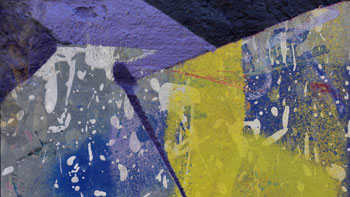
A musical and visual interpretation of a passacaglia by the Baroque composer Bernardo Storace. The music is performed by me on a copy of a Baroque harpsichord originating from the same city and period as the composition itself.
The visual dimension is constructed from a series of fragments extracted from my own “abstract” photographs. Closely following the structure of the music — a sequence of variations built upon a repeated ground bass and divided into six sections (partite) — the imagery evolves in parallel with the score.
Each section possesses its own distinct musical character and, consequently, its own visual “colour.” Throughout the work, both music and imagery unfold in an almost imperceptible yet inexorable emotional crescendo, gradually drawing the viewer into a hypnotic state.
Les Ombres Errantes
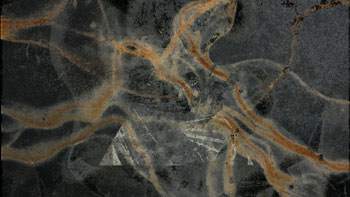
From the introductory text at the Traverse Video Festival (Toulouse, 2016):
Depuis l’Odyssée d’Homère, la descente au royaume des morts, qui avancent comme des ombres, est un chapitre obligé majeur de tout poème épique. Le titre comme la tonalité de la musique: Les Ombres Errantes de Couperin de 1730 rendent hommage à ce motif. La vidéo s’avère le commentaire visuel de la musique: elle débute sur l’obscurité absolue, attirant d’emblée dans un monde étrange, sans référence spatiale et dans un silence absolu. Une forme apparaît au loin, lorsqu’elle s’approche, nous y reconnaissons une sorte de triangle semi-transparent, à lire comme un symbole du surnaturel -mystique, rationnel? Accompagnatrice, venant plus près, elle ralentit alors la musique se lance et les ombres des ailes, les silhouettes, les formes se glissent et vont et viennent: quelques ombres tentent de s’avancer mais elles s’arrêtent et repartent, disparaissant comme des fantômes. D’autres passent, indifférentes errantes. (S. Dompeyre)
View on YouTubeToccata (3D video)
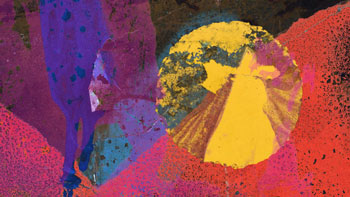
A sequence of five long-sustained notes forms the foundation of a musical landscape that gradually draws the listener into a state of near hypnosis. Significantly, these notes correspond to those of the Oriental pentatonic scale. Upon this elemental framework, the Baroque composer Girolamo Frescobaldi — one of the great innovators of experimental keyboard music in his time — constructs a rich and constantly shifting world of consonances, dissonances, chords, and virtuosic passages.
The result is a truly Baroque phantasmagoria, in which the restless movement of the musical discourse, articulated by the hands, contrasts with the incantatory stillness of the long notes sustained on the organ pedals. The prolonged G on which the work both begins and ends recalls the opening gesture of Indian classical music, where a single sustained tone evokes, in its primordial simplicity, the emergence of a world.
The video begins in darkness. As the first pedal note resounds, blue mists slowly emerge and take shape. With the first chord, a luminous disc — sun, moon, or planet — appears and gradually intensifies. As the music unfolds through successive harmonic landscapes, further forms materialize: alien worlds dominated by intense, almost elemental colours. The visual narrative develops in parallel with the music through a gradual crescendo of emotional intensity, articulated by a solemn progression of nearly static, slowly transforming side scenes, reminiscent of theatrical wings or coulisses.
Toward the conclusion, the luminous disc becomes increasingly imposing, mirroring the mounting insistence of the music as it approaches its final cadence — a radiant and peremptory reaffirmation of the note, though not the chord, from which everything first emerged.
The visuals are derived from original photographic material created by the author, who also performed and recorded the synchronized music on an ancient Italian organ.
View on YouTubeNaumachia (3D video installation)
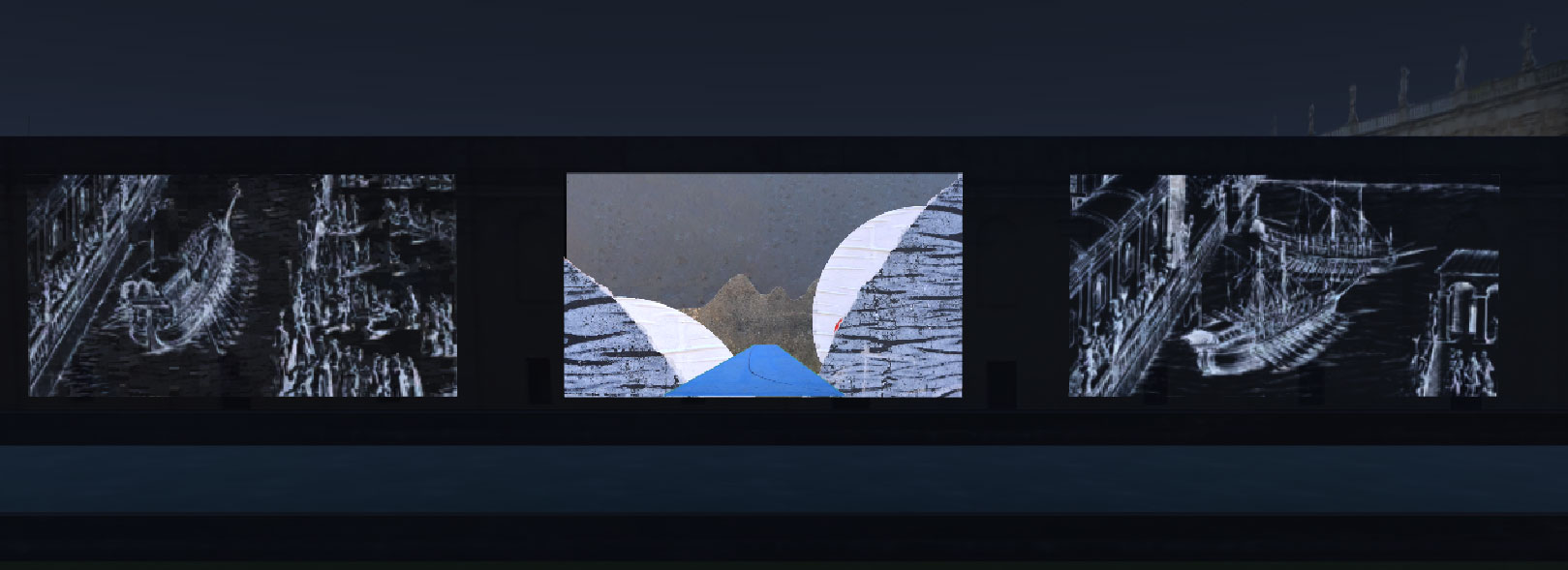
Naumachia was conceived to evoke the naval battle spectacle staged in 1685 in the basin along the left wing of the Villa Contarini (Piazzola sul Brenta, Italy), as part of a reception for the Duke of Brunswick. Designed as an immersive experience, it extended approximately 40 meters along the side wall of the Villa, and combined synchronized lighting, wall projections, and a 3D video to create a dynamic scene. This scene appeared to emerge from the side building and project across the water basin toward the audience, who were positioned on the field opposite. Due to budget constraints, however, only the 3D video component could be realized. It was presented on a smaller screen installed on the field, in front of—rather than beyond—the water basin.
View on YouTube